
Erroneous member benefit data continues to drive overpayments across health insurance plans when other coverage is discovered after claim payments. The performance of a coordination of benefits (COB) recovery program depends largely on when the correct primary payer is identified for a member.
That timing directly affects financial outcomes, administrative workload, and the overall value a health plan realizes from its COB recovery program.
When other coverage is identified after claim payment, a successful recovery effort must be completed for the plan and the member to realize the savings from correctly coordinated claims. Even when overpayments are identified, not all dollars are ultimately recovered, leaving claims unproperly coordinated. This creates an unnecessary burden on health plans and their members.
Timing changes that equation.
Plans can identify other coverage after payment, during adjudication, or before a claim is submitted.
The COB strategy a plan chooses to utilize impacts how dollars move through the system, how labor is utilized to manage overpayments and how much value the plan retains.
This article examines the three primary approaches to COB: post-pay, pre-pay, and pre-claim. Each model illustrates how detection timing changes cash flow, administrative burden, and overall program performance.
We’ll start with the traditional post-pay model, where plans identify other coverage only after funds are disbursed.
The traditional model: post-pay COB recovery
Post-payment recovery is how most organizations historically conducted COB. A claim is adjudicated and paid. Only later does the plan discover other primary coverage, requiring recovery efforts to correctly coordinate benefits for their members.
This approach places greater reliance on recovery teams and results in higher administrative costs and lower overall program value. As a result, COB programs have evolved around reactive recovery operations rather than building an effective solution based on prevention.
The speed at which new primary coverage can be identified greatly impacts the effectiveness of a COB solution. Health plans have historically been tied to the post-payment approach due to a lack of trustworthy data, cumbersome processes to updating membership eligibility, and the lack of a market solution with the necessary resources to prevent COB overpayments.
What drives post-pay recovery performance
In this model, investigation for other coverage begins after payment has already occurred. Financial performance depends on how effectively overpayments can be identified, validated, and recouped.
Accurate and timely claims and eligibility data determine how quickly teams detect other coverage post payment. The longer identification takes, the lower the probability of successful recovery. State recovery rules and provider contract limitations often restrict recoupment if overpayments are not identified within required timeframes. Data delays or gaps reduce collection probability.
Provider responsiveness and contract strength shape recovery yield. Clear recoupment language and established outreach processes improve recovery rates, while disputes and appeals can extend recovery timelines.
Because recovery occurs after disbursement, administrative cost directly reduces net yield. Plans recapture cash later after having incurred expense to pursue the overpayment, and, even then, some validated dollars go uncollected.
As a result, recovery efficiency directly determines post-pay COB performance.
When post-pay remains necessary
Post-pay COB recovery will never be obsolete. There are situations where earlier identification simply is not possible, such as:
- Retroactive eligibility or Medicare entitlement after medical treatment has occurred.
- Edge cases falling outside the reach of pre-pay processes.
- Inaccurate information received during the initial investigation from a group or member
In these scenarios, recovery after payment is unavoidable.
Post-pay programs remain an important safeguard. They capture value that would otherwise be permanently lost.
Plans seeking to reduce volatility, operational friction, and stakeholder friction must shift identification earlier in the claims lifecycle whenever feasible. The earlier coverage is confirmed, the less the organization relies on downstream recovery.
The prevention model: pre-pay COB
Pre-pay shifts coordination of benefits identification into adjudication, before payment is released. COB knowledge workers verify primary coverage during claim review. When other coverage is identified, payment responsibility is correctly updated before funds leave the plan.
Rather than pursuing dollars after disbursement, this model prevents overpayments from occurring in the first place. The result is a different financial profile and a different workload pattern for payment integrity teams.
Operational implications inside claims
Moving COB identification into the adjudication process changes the distribution of work across the payment integrity function. Instead of building downstream recovery queues, claims are coordinated correctly the first time. Investigative effort shifts forward in the lifecycle.
Subject matter experts who previously devoted energy to post-payment recovery can now identify overpayment signals before the claim is paid.
The shift to pre-pay requires a capacity to quickly investigate other coverage prior to payment release. Teams must validate coverage in real time in order to comply with legal and contractual payment requirements. This capability requires integrated technology platforms supported by experienced analysts.
Financial impact beyond cost avoidance
The pre-pay model improves more than gross overpayment prevention. It changes the financial mechanics of COB.
When other coverage is identified before claim payment, savings are realized at the time of adjudication instead of through post-disbursement collection. This increases predictability because value is no longer dependent on provider responsiveness or recovery yield.
Working capital timing also shifts. Plans retain funds instead of releasing and then pursuing them. The money remains within the plan, reducing the lag between primary payer identification and financial impact.
Administrative expense declines relative to post-pay models because fewer dollars enter the recovery lifecycle. As recovery volume decreases, collection cost and appeal management efforts diminish.
The result is a higher proportion of identified value translating into retained value. Net program performance becomes less variable and return on investment increases from the COB solution
Realizing this financial benefit depends on reliable eligibility integration, appropriate staffing, and timely claim feeds. Without accurate upstream data, pre-pay identification cannot perform consistently, and projected savings may not materialize.
The data integrity model: pre-claim COB
Pre-claim COB operates upstream at the patient coverage level. Rather than identifying other coverage during or after adjudication, it corrects eligibility data before a member incurs a claim. The focus is on improving data integrity, so adjudication logic reflects accurate primary coverage from the outset.
For this reason, the value of pre-claim COB lies in strengthening data integrity to prevent future overpayments and support sustained savings.
Correcting coverage data upstream
In the pre-claim COB solution, overlapping coverage is investigated to identify the correct order of benefits. COB indicators—such as new employment or changes in marital status—within eligibility systems, are used as clues to discover other coverage.
The member’s COB data stores are corrected to ensure adjudication logic reflects accurate primary and secondary status before claims processing.
The objective is to establish a complete and accurate record of all available coverages for the member so all future claims can be coordinated correctly, rather than intercepting isolated overpayments.
Suppressing repeat leakage
Coverage errors rarely affect a single claim. A member with incorrect primary designation can generate multiple incorrect payments over time.
Pre-claim COB corrects the benefit payment order at the source. Future claims adjudicate correctly without additional investigation or post-payment recoupment.
Over time, recovery demands decline because fewer errors repeat across claim cycles, making COB less reactive and more predictable.
Together, these approaches represent increasing levels of COB program maturity.
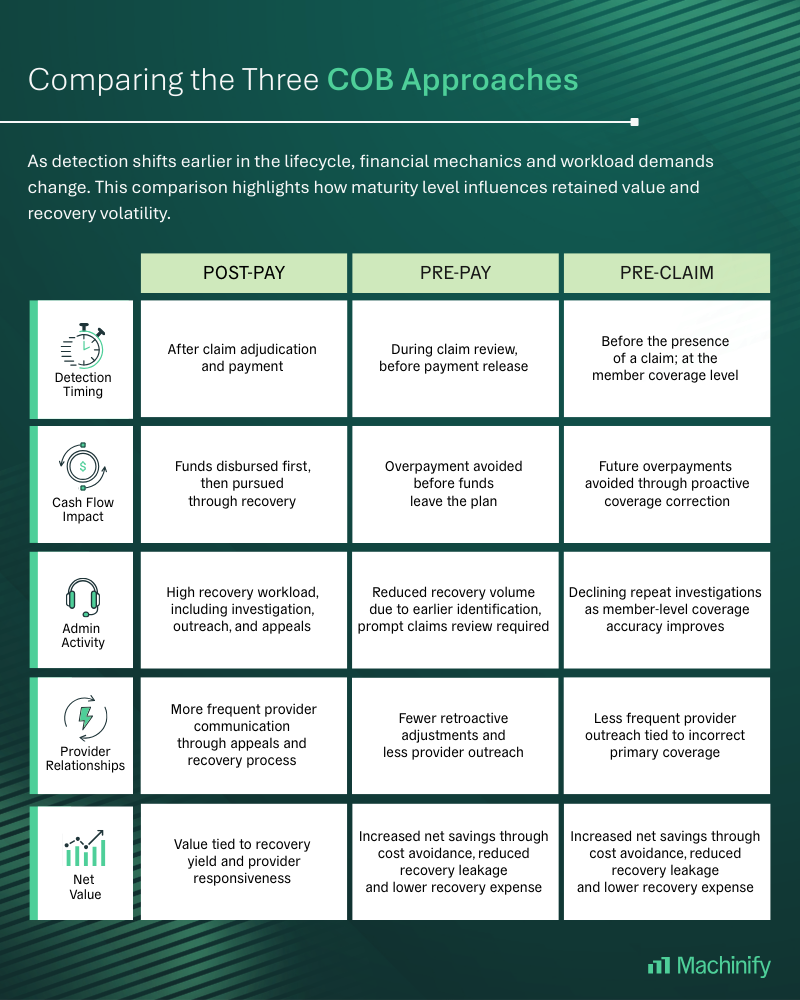
Comparing the three COB approaches
As detection shifts earlier in the lifecycle, financial mechanics and workload demands change. This comparison highlights how maturity level influences retained value and recovery volatility.
How integrated COB support fits into this framework
For many health payers, the question is not which model to choose, but how to layer them together for the best value. A common approach combines pre-claim and pre-pay identification with post-pay COB recovery support under a fixed per member per month pricing structure.
Under this integrated approach, teams conduct daily pre-claim member reviews. When new primary coverage is discovered, the member’s COB information is updated immediately, ensuring future claims are coordinated correctly.
The small volume of overlapping coverage instances not identified prior to or during adjudication continues to decline over time, improving net savings.
By aligning identification and recovery within a single structure, incentives remain consistent across the lifecycle. Earlier detection benefits members and providers while reducing downstream recovery dependency.
Post-pay capacity preserves value in scenarios that teams cannot prevent upstream.
Structuring COB recovery for long-term performance
Long-term COB recovery performance depends on when—and how—payers identify primary and secondary payer coverage for their members.
The most cost-effective strategies realize savings by correcting COB information at defined intervention points before and during the life of claim. Layering COB processes improves payment accuracy, reduces operational friction, and enhances the claims experience for providers and members.
With the right solution, coordination of benefits y shifts from reactive recoupment to proactive financial management.
Determining where in the lifecycle coordination of benefits takes place is a crucial decision for payment integrity leaders. That decision shapes financial stability, workload predictability, and long-term program value.
Connect with our team to benchmark your COB recovery performance and evaluate how earlier-stage identification may improve net value and workload stability.
The content on this page is subject to our Terms of Use.


